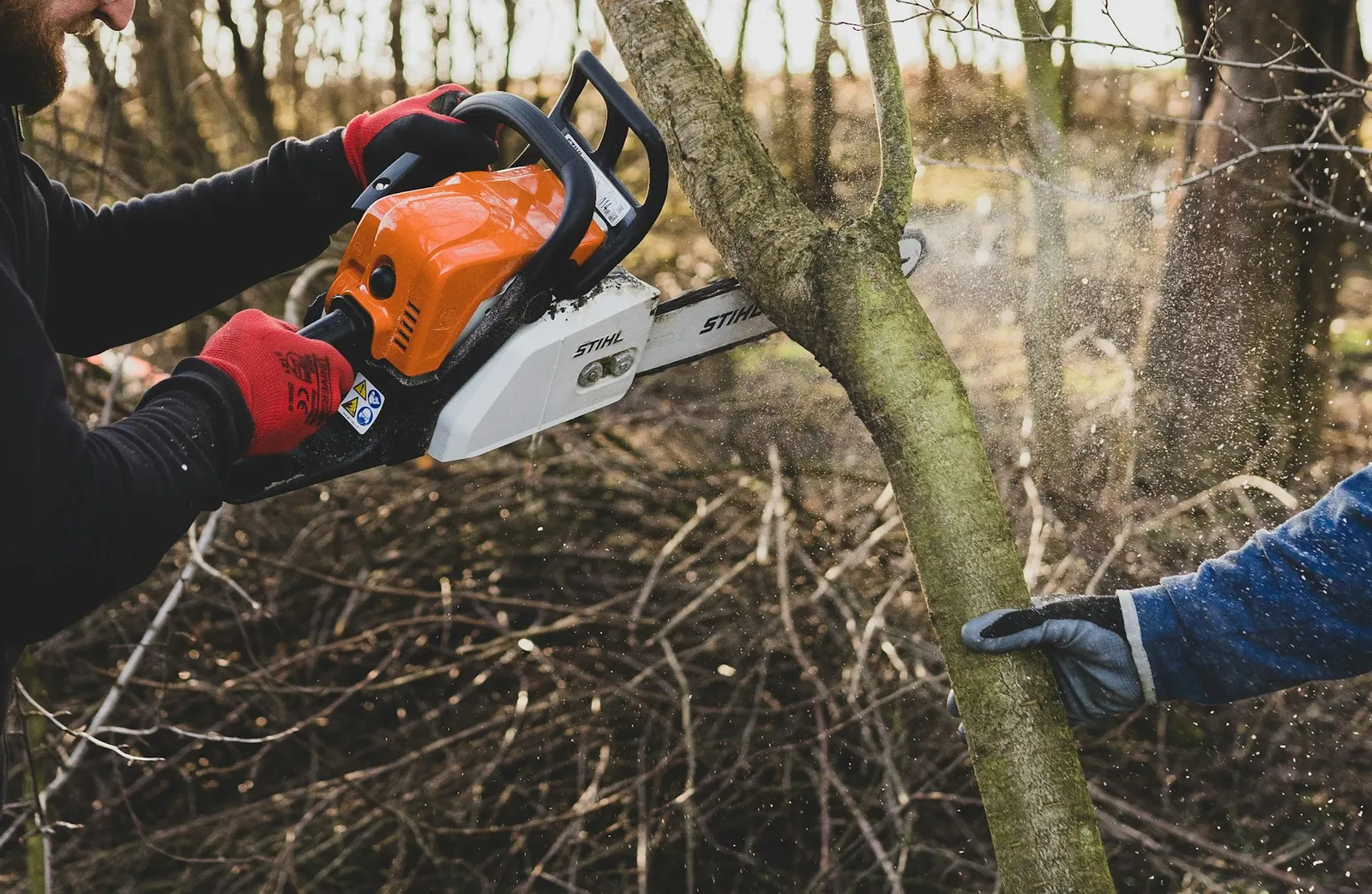
You are forty feet up an oak with a saw running. Your phone is buzzing in the truck. It rings seven times, then goes to voicemail. The homeowner on the other end hangs up and calls the next company.
Nobody did anything wrong. It is just what the job is. A text-back is a simple way to fix it without asking your crew to do something they cannot do.
Why crews cannot answer
Let me say it plainly, because I think many owners feel guilty about it:
- Height. You are in a harness or a bucket. You do not reach for a phone up there. You should not.
- Saw and chipper noise. Even if you could pick up, the caller would hear a roar. You would not hear them.
- Gloves and gear. Heavy gloves, a helmet, ear protection. A touchscreen is the last thing you want to deal with.
- Safety. A distracted climber is a risk. The best crews put the phone away on purpose.
So the real problem is not “answer the phone faster.” It is “what happens to the caller while the crew works?”
Why the missed call matters
About 27% of calls to home-service businesses go unanswered, and under 3% of those callers leave a voicemail (Invoca). The caller is not mad. They are just busy finding someone who will answer.
In our October 2026 check of 4,108 tree company websites, 92% had no way to text or chat, and 93% had no online booking. So when the phone is missed, there is often nowhere else for the homeowner to go.
What a 30-second text-back looks like
The idea is easy. When a call is missed, a text goes out from your own business number within about 30 seconds. It says:
- Who you are.
- That you saw the call.
- One easy question or link.
- How to stop messages.
That is it. No long pitch. No sales talk. Here is the same thing as a table:
| Part | Example wording | Why it matters |
|---|---|---|
| Who you are | Oak & Pine Tree Service | The caller knows it is you |
| That you saw the call | Sorry we missed you | Shows you care |
| One easy step | Reply here or book a time | Easy to answer |
| Opt out | Reply STOP to opt out | Required and respectful |
Try it: build your own wording in the text-back script tool. The homeowner gets a reply while they are still holding their phone, and many people will answer a text when they would not leave a voicemail.
Four example texts
These are examples for a made-up company called “Oak & Pine Tree Service”. They are not real messages from a real business. Each one is under 160 characters, so it fits in a single text.
1. The basic missed-call text
Oak & Pine Tree Service: Sorry we missed you! What can we help with? Reply here or book: example.com/book Reply STOP to opt out
2. The photo request
Hi, Oak & Pine here. We’re on a job. Send a photo of the tree and your address and we’ll text back soon. Reply STOP to opt out
3. The after-hours text
Oak & Pine Tree Service: We’re closed for the night. Tell us what you need and we’ll reply first thing. Reply STOP to opt out
4. The storm-day text
Oak & Pine: Busy with storm calls. Is anyone in danger? Reply EMERGENCY, or send your address and photo. Reply STOP to opt out
A few notes on these:
- They sound like a person, not a robot.
- They ask for one thing. Not three.
- The STOP line is in every one. Keep it, even if it feels clumsy.
- Check each text for your own length. If your name is longer, trim the wording. A text slightly over 160 characters still sends, but it may split in two.
Legal basics, in plain words
I am not a lawyer and this is not legal advice. Talk to a lawyer if you have questions about your own situation. But these three rules cover the basics most small companies need to know:
1. Only text people who contacted you first. A missed-call text goes to someone who just called you. A reply goes to someone who just messaged you. That is a conversation they started. Do not text people from a bought list or people who have never been in touch. That is cold texting, and it is where companies get into trouble.
2. Always include a way to opt out. Every text should say how to stop, such as “Reply STOP to opt out.” When someone replies STOP, stop right away. Do not text them again.
3. Register your number for business texting. In the US, carriers expect businesses that send texts to register their number and say what they use it for. If you skip this, your texts may be blocked or slow to deliver. The steps depend on the service you use, so ask them how it works.
Keep a record of who texted you and when. The text compliance checker can check your wording, the texting rules guide goes deeper, and the glossary explains opt-out and STOP, TCPA and A2P 10DLC. If a question ever comes up, you can show the person reached out first.
What to do with the reply
The text-back only matters if something happens after the reply. Here is a simple routine:
- Read it at the next break. You do not have to answer in the tree. A reply within a few minutes of a break still feels fast.
- Sort it. Is it an emergency, a normal estimate, or a question? Treat emergencies first.
- Ask for a photo and an address if you do not have them yet.
- Offer a time. Send a booking link or two time slots. Do not leave it open-ended.
- Follow up once if they go quiet. A short note the next morning is fine. Then let it go.
- Mark the outcome. Booked, quoted, no answer, or not a fit. Even a simple note helps you see what works.
If nobody on your crew can do this, hand it to an office helper or a system. Read the missed calls guide for options, and use the follow-up text templates for the next step. The point is that the reply does not sit unread for six hours.
Start small
You do not need a perfect setup. Start with one text, sent to people who just called you, with a STOP line. Watch what comes back for a week. Adjust the wording until it sounds like you.
If you want to see how your company handles missed calls and messages today, the free audit shows you. And if you would like the text-back, the follow-up and the booking link handled for you, that is what the Never-Miss-A-Job System is built for.


